
The FIDE World Rapid & Blitz Championships, which were held in New York City from December 26 to 31, have spelled that the future of chess may not be so certain.
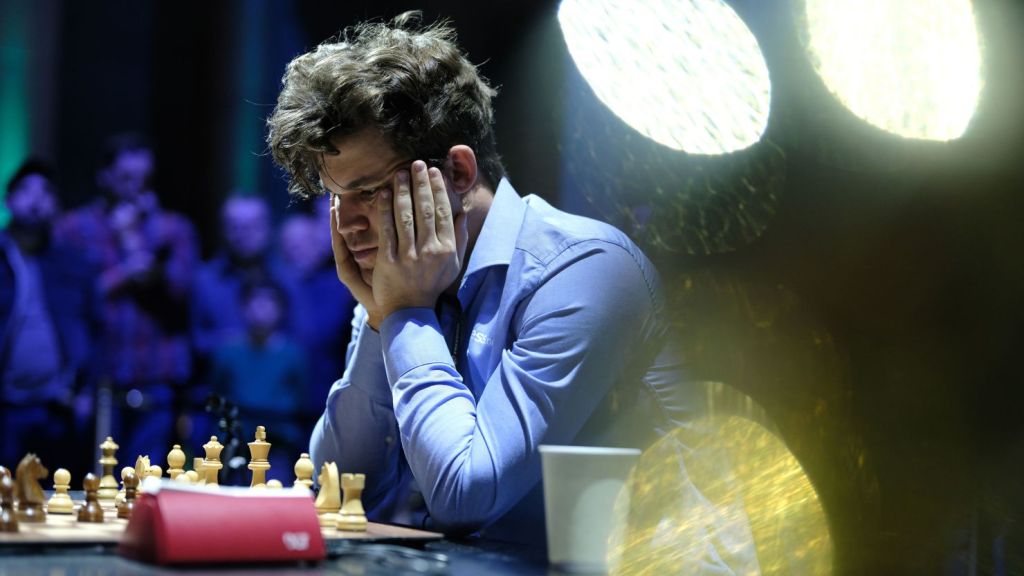
Magnus Carlsen has been ranked the #1 chess player globally for over ten years now. The 34-year-old Norwegian is arguably the greatest player to ever take up the game, but his relationship with the largest chess federation in the world has been a rocky one. FIDE, or the International Chess Federation, has long been criticized by many top grandmasters for its unwaveringly traditionalist policies, but none of said GMs seem to hold the sway that Magnus does. Carlsen’s quality of play over the course of his storied career can be described as nothing short of astounding, epitomizing the true zenith of the game, and with that level of success naturally comes a great deal of clout and influence. Simply put, Magnus directs eyes onto the game, acting as the selling point to casual fans, and this brings in sponsors and ultimately fosters the game’s growth.
This all sounds jolly, right? But how could we forget the age-old adage: it’s lonely at the top. Calling Carlsen head and shoulders above his grandmaster peers might be a bit of an understatement, what with his five World Chess Championship (WCC) titles, five World Rapid Championship titles, and eight World Blitz Championship titles, and you would not be entirely wrong in wondering if he has perhaps lost some of his motivation in recent years. Most evidently, Carlsen abdicated his throne in 2021 and retired from the WCC cycle, wherein he would convincingly defend his coveted title against fellow first-rate GMs every couple of years or so. Not only did he willingly relinquish his title undefeated, but he also only lost two out of the cumulative fifty-six games played across the five classical matches (2013, 2014, 2016, 2018, 2021), a staggeringly dominant string of performances to say the least.
It was not, however, just Carlsen’s established and repeated dominance that led him to vacate the title, but also FIDE’s unwillingness to comply with his demands. According to Magnus, he simply no longer finds the enjoyment in competing in the WCC that he once did, citing the excruciating levels of preparation required for the match as a reason, as well as the long and taxing hours actually spent at the chessboard over the course of the few weeks during which the match takes place. One of his most legendary (and lengthy) games was the sixth of his match against GM Ian Nepomniachtchi in the 2021 WCC held in Dubai, which went on for a record 136 moves and an elapsed 7 hours and 45 minutes, extending beyond midnight local time; the game ended in a triumphant victory for Carlsen, reminding us why he is the undisputed world #1 while also exemplifying how arduous longform classical chess can be. Notably, this was the last time Magnus participated in the classical World Chess Championship, as FIDE did not yield to his wish of a greater number of shorter games to comprise the match.
So where does this leave Magnus? Even outside of the WCC cycle, he barely ever plays classical chess anymore, instead preferring to play with shorter time controls (“speed chess” as we would call it), and the World Rapid & Blitz Championships fall under such a category. These joint tournaments essentially act as the acme of competition in the rapid and blitz formats, with the best titled players in the world congregating in New York City to compete for an official World Championship title. To further clarify, the time control for the rapid portion was 15 | 10, meaning that each player had 15 minutes in total to make their moves and that an increment of 10 seconds was added to the player’s clock who just made a move (this applies to every move made). The time control for the blitz portion was 3 | 2, with the same principles applying.
Because of the shorter time controls, players compete in a greater volume of games in the rapid and blitz formats as opposed to classical, which is typically relegated to one game per day for each player. Speed chess also demands a strong sense of intuition, as there’s simply no time for the deep, complex positional and tactical calculations that are necessary for longform classical games. Additionally, such games do not require anywhere near the same level of preparation done beforehand, as it would merely go to waste.
The case for Freestyle chess
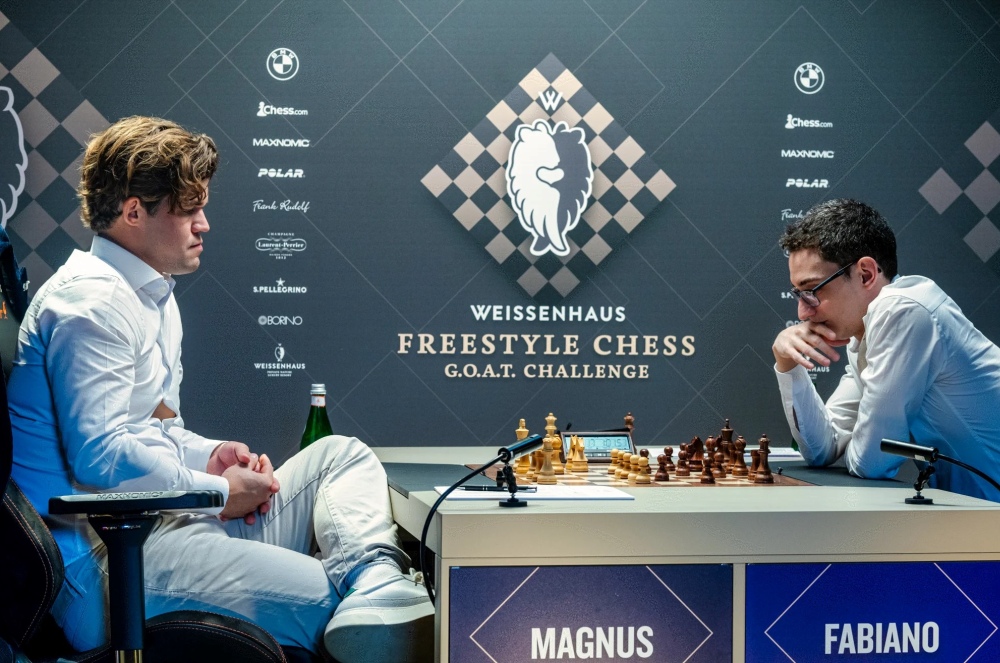
I should now clarify what I mean by “preparation,” how it’s evolved over the years, and how the prospective rise of a new chess variant seeks to erase the need for such an intense pretournament undertaking, with Magnus acting as its biggest proponent—and FIDE its biggest detractor.
Heading into big classical tournaments, grandmasters need to partake in the long and grueling preparation necessary for their success, with this prep consisting of intense studying and memorization of the complex lines that comprise accepted chess theory, or the “meta” of the game in other words. Typically, you would need to approach each game with several ideas in mind, and such studying serves as a mode to hopefully catch your opponent off guard and gain an advantage in the opening. After a certain point in any given game, players graduate from their prep and dive into the middlegame and later the endgame, wherein tactics and pure chess-playing ability replace memorized lines. That a grandmaster would neglect to familiarize themselves with such theory would be unmitigated disaster, as every GM goes into classical games with what is essentially the best and most testing prep in the world. And such preparation is only getting deeper and more complex.
Preparation for classical chess tournaments has always been dynamic, but the accepted theory has never progressed as rapidly as it has with the recent advent of uberpowerful chess engines such as Stockfish, which calculate at such an astonishing level of play that no human in the world, not even Magnus Carlsen, could best them in a game. These chess engines also serve as a vital tool for grandmasters, as they allow for players to bolster their preparation and acquire insight into how any given line would play out in a game. Stockfish has become necessary for players if they want to succeed in classical chess, but the amount of blind memorization, combined with the sheer volume of tournaments that GMs need to play every year if they want to earn money and continue to receive invites, means that players are perennially exhausted, especially those slightly older players like Magnus who have been competing for quite some time now and no longer have as much to prove.
There is, however, a fascinating chess variant that stands as a completely different breed of the game, which nullifies the need for any extensive preparation done beforehand and still works in longer time controls. In fact, said variant might even function better in longform, and Magnus is the one spearheading its popularization. Said variant is being branded by Magnus as “Freestyle” chess, and it entails that each of the players’ back ranks (the first and eighth rows of the chessboard) contains an entirely new and randomized configuration of pieces. This means that the king, queen, bishops, knights, and rooks are all in different positions from the standard chess setup, and this configuration is the same for each player’s back rank. Freestyle chess has also long been known as “Fischer random” or “960,” with the former being in reference to its creator, infamous GM Bobby Fischer, and the latter being in reference to the 960 unique starting positions that the mode of play offers.
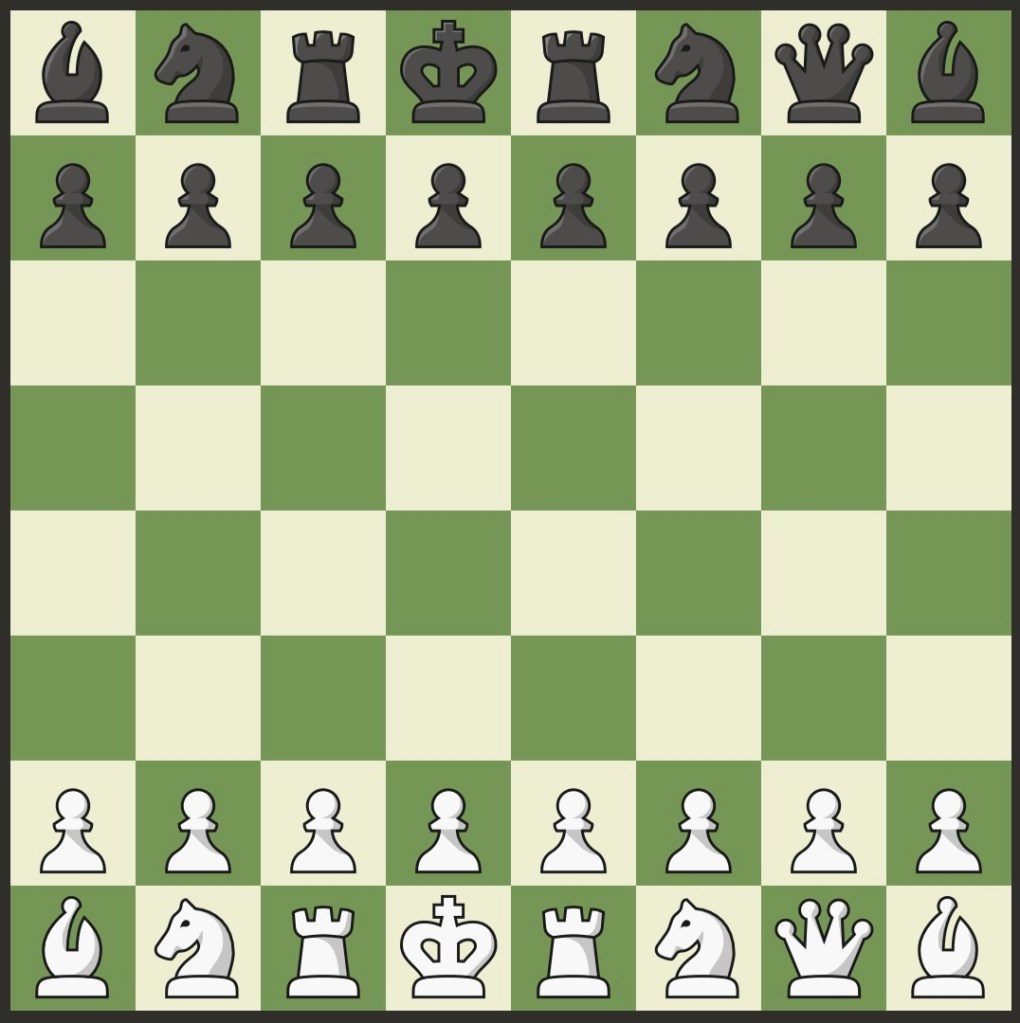
Because of the myriad of possible starting positions in Freestyle, accepted theory does not apply the way it does to standard chess. GMs spend their lives studying the standard starting position and all of its complexities, yet that theory only comprises a measly 1/960th of the overall sum of theory that Freestyle would boast—this is not to imply that chess is solved or that accepted theory is “complete,” but rather to serve as a visualization of how much Freestyle offers to players who are bored of classical. And it’s because of how relatively little GMs know about the specific intricacies of Freestyle that games within this variant would naturally be more erratic and theoretically fresh.
In terms of visibility, Freestyle gets a fraction of the attention that classical chess does, and while FIDE does every now and then host its own World Fischer Random Chess Championship (WFRCC), they hold a clear preference for standard chess. Thus, in tandem with German entrepreneur Jan Henric Buettner, Magnus has founded the Freestyle Chess Players Club (FCPC) in an effort to popularize the variant and reinvigorate many top grandmasters’ enthusiasm for chess, and players have been more than receptive to join. The FCPC includes 25 of the world’s most elite GMs, such as Hikaru Nakamura, Fabiano Caruana, Nodirbek Abdusattorov, Levon Aronian, Alireza Firouzja, and current World Champion Gukesh Dommaraju. The club has already hosted a 960 tournament, the Freestyle Chess G.O.A.T. Challenge, which took place from February 9-16, 2024, with Magnus taking home the gold; it was the first major 960 tournament to be played with longer time controls. The format for a longform Freestyle tournament would entail that players are only shown the randomized position thirty minutes before their game, during which they may briefly but meaningfully calculate lines and form strategies, which stands in stark contrast to the months of preparation typically required of players heading into a classical tournament.
FIDE, however, appears not so keen on the FCPC’s decision to dub the winner of its newly launched Freestyle Chess Grand Slam Tour a “World Champion” in their own right, asserting in a recent X/Twitter post that “the attempts by FCPC to present their project as a World Championship are in contradiction with the well-established status of FIDE and its authority over world championship titles in all relevant variations of chess – including Chess960/Freestyle chess,” with these tensions having lingered since before the World Rapid & Blitz. They also maintain in the post that any player part of the FCPC must sign a contract indicating that their participation in any future “World Championship” tournament of any chess variant not overseen by FIDE would lead to their withdrawal from the next two WCC cycles—a mighty cost to incur for any World Champion hopefuls (this does, however, exclude the 2025 Freestyle Grand Slam Tour).
Magnus has obviously pushed back on FIDE and their efforts to squash the FCPC, and it’s evident that the two parties are not on good terms. It raises some urgent questions, though. Why would FIDE exacerbate relations with their greatest asset and number one draw? Do they view Magnus and the FCPC as a threat to their power? And perhaps Freestyle as a threat to the sanctity of the game?
‘Jeansgate’ and co-champions
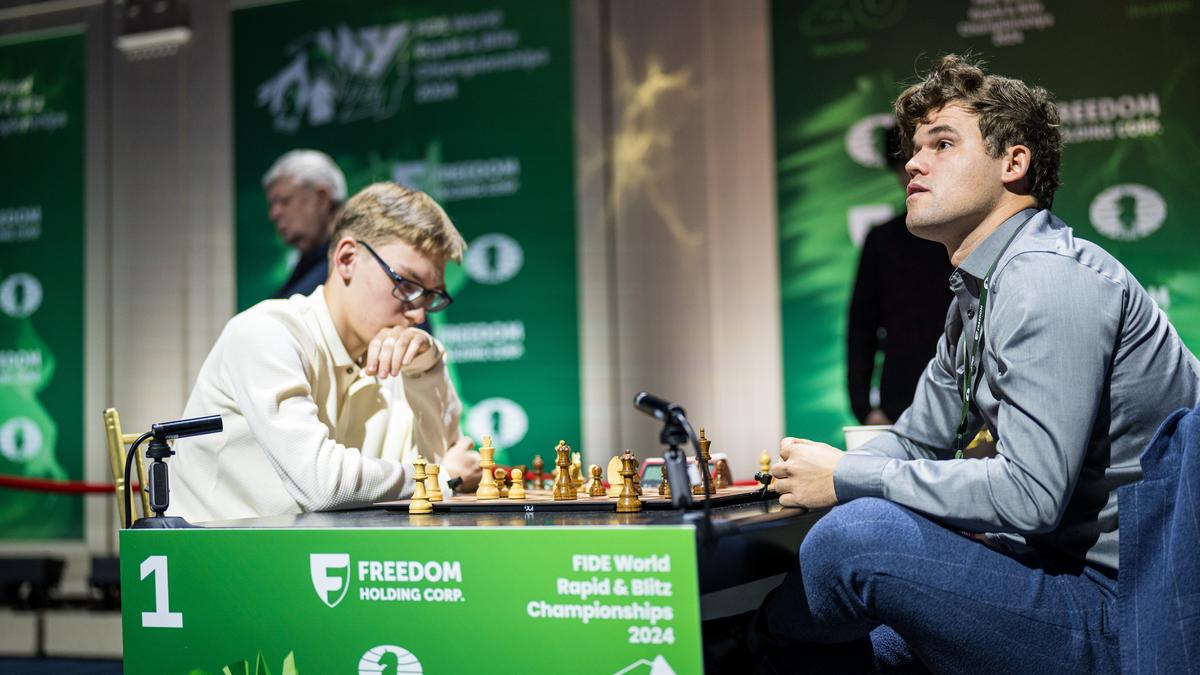
The FIDE World Rapid & Blitz Tournaments were held from December 26-31, 2024, in New York City, and heading into the tournaments, relations between FIDE and Magnus weren’t exactly great. Magnus has expressed that FIDE was already on “thin ice” with him after their repeated attempts to hinder his endeavor into Freestyle, along with any player that partakes in the club. But things were not to end there: on the second day of the rapid portion, Magnus showed up in jeans, which violated the official dress code for the event, and FIDE issued him a $200 fine and required that he change out of his jeans into proper attire as soon as possible, meaning that he would need to return to his hotel in between rounds. Magnus did not abide and instead withdrew from the remainder of the World Rapid Chess Championship, asserting that he would no longer participate in the blitz portion either in an act of rebellion against FIDE and their incessant meddling. Magnus went as far as to say that it was “full on war” with FIDE, adding, “It’s okay, like, they can enforce their rules. That’s fine by me, and my response is that, ‘Fine then, I’m out, like, fuck you.’”
What’s interesting is that FIDE was not impartial in their enforcement of the dress code—there were reported to be several other lower-ranked players in attendance who did not abide by the dress code but did not suffer any punitive action from FIDE, which likely stems from the fact that Magnus draws the most eyes, meaning that his appearance more than anyone else’s affects how FIDE and the game as a whole are perceived by the public. But what FIDE fails to understand is how the game of chess has evolved over the past few centuries, and even over the past five years—they are overly attached to the antiquated idea that chess is a highbrow, elitist game reserved only for the most successful and rarefied members of the aristocracy, as if knowing how to play this fundamentally simple strategy game is an indicator of great intelligence and enviable social status. And this obdurate resistance to change is manifested through the short leashes on which they keep their players and, in this case, their insistence upon the inviolability of the sacred dress code.
If you’re even remotely familiar with the chess world, then you’re likely aware of the boom in popularity the game experienced in 2020 when the pandemic had just begun. That, too, was a watershed moment in the history of the game, one where online chess exploded in popularity and began to attract millions of more players to sites such as Chess.com and Lichess. Speed chess, being a format that lends itself well to an online setting, also burgeoned in popularity, with the game slowly evolving into a proper esport. With the unlimited resources at one’s disposal, anyone could learn the ins and outs of chess even if they had never played before, which is a far cry from the historical standard of chess being a game reserved for the elite. It seems that FIDE would rather continue to gatekeep the game ad infinitum while Magnus remains actually interested in growing the game and exposing it to new audiences while also benefitting the players—he rightfully recognizes that chess is ever-evolving and that stagnation is perhaps the worst thing that could befall the sport.
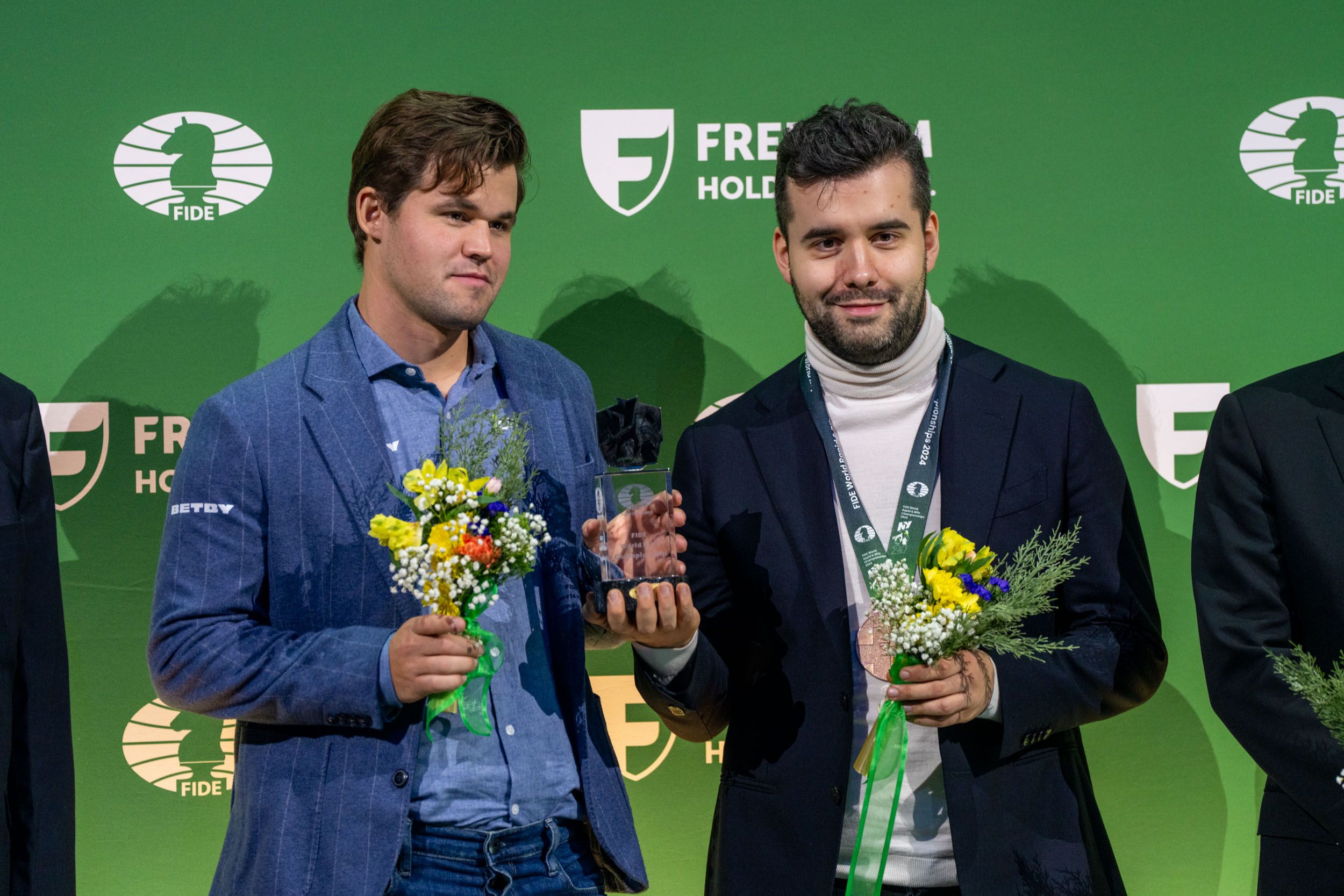
After dropping out of the rapid section, Magnus and FIDE were able to “resolve” their issues so that he would return to play the blitz portion, but he would only do so if he were allowed to don the jeans once again. In spite of FIDE’s attempts at authority, Magnus is still the main appeal to these events from the perspective of the general public and sponsors, and hosting the blitz portion without him would admittedly leave a yawning hole in the field.
Out of a pool of 188 players, the final of the World Blitz Chess Championship came down to Magnus Carlsen and the previously mentioned Ian Nepomniachtchi. The format for the final match was a best of four; the first player to score 2.5/4 would claim their next World Championship title. Magnus won the first two games, bringing his score to 2/2, and he would only need a draw in the third game to bring home the gold. However, Ian would make a stunning comeback by winning two games in a row, bringing each player to a score of 2/4. The two would duke it out for three more games, drawing each and every time and making the impending result seem ever more uncertain. With both players sitting on a score of 3.5/7, Magnus eventually suggested that the two of them split the World Blitz title, and Ian agreed.
What’s more interesting, however, is that FIDE even allowed this to happen. The notion of splitting a World Championship title sounds ridiculous the moment you hear it: should we too split the actual classical World Championship? Who’s to say any given future World Championship shouldn’t be split when the players reach a brief deadlock? And one can’t help but wonder if FIDE were scared of how Magnus would react if they were to deny his request to split the title. Even more surprising is the flippancy with which Magnus addresses the situation, murmuring to Ian, “If they refuse, we can just make short draws until they give up,” which sounds uncomfortably close to match fixing if you ask me. And as much as I’ve come to the defense of Magnus during all of this, it does feel that perhaps he’s abused his power, knowing that FIDE was inclined to appease him lest he make a scene again. And don’t get me wrong! I’m all for sticking it to the establishment, but I also think that it’s important to keep both parties in check.
A great schism incoming?
With all that we know now, it’s hard not to feel like there’s a marked divide between the interests of FIDE and the interests of Magnus (and by extension, the rest of the top players). Magnus’ priorities really do seem to lie with the FCPC and the several additional Freestyle tournaments they have planned for the remainder of the year. And in a recent interview given to Norwegian TV station TV 2, Magnus explains, “What I can say now is that the relationship that my team and I have with FIDE is pretty destroyed. At least with the current administration.” It seems now that Magnus has firmly divorced himself from FIDE, and so it remains to be seen the traction that Freestyle will gain throughout 2025. In the meantime, the Freestyle Chess Grand Slam Weissenhaus is currently taking place from February 6-14, 2025, at which Magnus will take on fellow super GMs such as Hikaru Nakamura, Fabiano Caruana, and current World Champion Gukesh Dommaraju. The chess will no doubt entertain.
 Focal Blend
Leave a comment